

Hey there! I'm a supplier of vertical multistage pumps, and I've been in this game for quite some time. One of the most crucial components of these pumps is the impeller. You might be wondering, "How does the impeller design affect a vertical multistage pump?" Well, let me break it down for you.
1. Flow Rate
The impeller design has a direct impact on the flow rate of a vertical multistage pump. The shape and size of the impeller vanes play a significant role here. If the vanes are designed to have a larger passage area, the pump can handle a higher volume of fluid. For example, an impeller with wide and curved vanes allows the fluid to flow more freely through the pump. This reduces the resistance and enables the pump to move more water in a given amount of time.
On the other hand, if the impeller vanes are narrow and have a more restrictive passage, the flow rate will be lower. This might be useful in applications where a precise and lower flow rate is required. But for large - scale water supply systems or industrial processes that need a high volume of fluid transfer, a well - designed impeller with a large flow area is essential.
Our Vertical Inline Water Pump High Pressure Water Circulation Pump is designed with impellers that are optimized for different flow rate requirements. Whether you need a high - flow or a low - flow solution, we've got you covered.
2. Head Pressure
Head pressure is another critical factor affected by impeller design. The head pressure refers to the height to which the pump can lift the fluid and the pressure it can generate. The number of impeller vanes, their shape, and the rotational speed of the impeller all contribute to the head pressure.
A greater number of impeller vanes can increase the head pressure. Each vane imparts energy to the fluid as it rotates, and more vanes mean more energy transfer. The shape of the vanes also matters. Vanes with a backward - curved design can generate higher head pressures compared to forward - curved vanes. This is because backward - curved vanes are more efficient at converting the rotational energy of the impeller into pressure energy of the fluid.
In our CDL/CDLF Series Light Vertical Multistage Centrifugal Pump, we've carefully selected the impeller design to achieve an optimal balance between flow rate and head pressure. This ensures that the pump can perform well in various applications, from small - scale building water supply to industrial cooling systems.
3. Efficiency
Efficiency is a big deal when it comes to pumps. A well - designed impeller can significantly improve the efficiency of a vertical multistage pump. When the impeller is designed to minimize internal losses, such as friction losses and leakage losses, the pump can convert more of the input power into useful work of moving the fluid.
For instance, a smooth - surfaced impeller reduces friction losses. The fluid can flow more easily over the smooth surface, and less energy is wasted in overcoming the frictional forces. Also, a properly sealed impeller reduces leakage losses. Leakage occurs when some of the fluid bypasses the normal flow path and doesn't contribute to the pumping action.
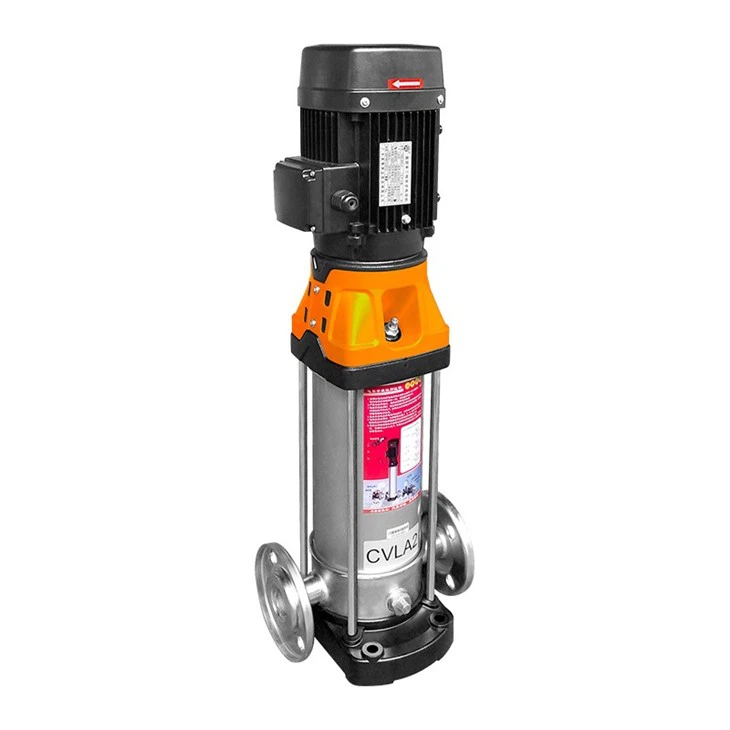
Our CVLA Series Light Vertical Multistage Centrifugal Pump features impellers that are designed for high efficiency. This means lower energy consumption and cost savings for you in the long run.
4. Cavitation Resistance
Cavitation is a phenomenon that can cause serious damage to a pump. It occurs when the pressure of the fluid drops below its vapor pressure, causing vapor bubbles to form. These bubbles then collapse when they move to a higher - pressure region, creating shockwaves that can erode the impeller and other pump components.
The impeller design can affect the pump's resistance to cavitation. An impeller with a well - designed inlet can prevent the pressure from dropping too low, reducing the likelihood of cavitation. The shape and angle of the inlet vanes can be optimized to ensure a smooth and uniform flow of fluid into the impeller.
We take cavitation resistance seriously when designing our impellers. We use advanced engineering techniques to ensure that our pumps can operate without being affected by cavitation, even in challenging conditions.
5. Noise and Vibration
A poorly designed impeller can cause excessive noise and vibration in a vertical multistage pump. Unevenly spaced vanes or an imbalance in the impeller can lead to vibrations. These vibrations not only make the pump noisy but can also cause premature wear and tear of the pump components.
By using precision manufacturing techniques and carefully balancing the impellers, we can minimize noise and vibration. Our impellers are designed to rotate smoothly, ensuring a quiet and stable operation of the pump. This is especially important in applications where noise levels need to be kept low, such as in residential or office buildings.

Conclusion
As you can see, the impeller design has a profound impact on the performance of a vertical multistage pump. From flow rate and head pressure to efficiency, cavitation resistance, and noise levels, every aspect of the pump's operation is influenced by how the impeller is designed.
If you're in the market for a vertical multistage pump, it's crucial to choose a supplier that understands the importance of impeller design. We've spent years perfecting our impeller designs to ensure that our pumps offer the best performance, reliability, and efficiency.
If you have any questions about our pumps or need help choosing the right one for your application, don't hesitate to reach out. We're here to assist you with all your pumping needs and can provide you with detailed information and a customized solution based on your requirements. Let's start a conversation and find the perfect vertical multistage pump for you.
References
- Pump Handbook: A Guide to Pump Technology and Applications.
- Journal of Fluid Mechanics: Research on Impeller Design and Pump Performance.