



Seawater swimming pools are becoming increasingly popular in seaside hotels, coastal resorts, marine parks and private villas. Compared with traditional freshwater pools, they can provide a more natural swimming experience and better match the surrounding coastal environment.
However, seawater is also more demanding on pool circulation equipment. A standard swimming pool pump may work normally at first, but continuous exposure to salt and chlorides can gradually affect the pump shaft, mechanical seal, fasteners and other wetted components.
For this reason, choosing a suitable seawater pool pump involves more than checking motor power and maximum flow. The pump must also have appropriate corrosion-resistant materials and a configuration designed for saline water.
Seawater Pools and Saltwater Pools Are Different
A saltwater pool usually contains a controlled amount of salt for a salt chlorine generator. Its salt concentration is normally much lower than that of natural seawater.
A seawater pool may use water taken directly from the sea or operate with a much higher salt concentration. This creates a more corrosive environment for the circulation pump and filtration equipment.
A pump described as suitable for a saltwater pool is therefore not automatically suitable for continuous seawater service. Before purchasing, it is important to confirm whether the pump is designed for ordinary salt-chlorinated pool water or manufactured according to a dedicated seawater standard.
The following problems may occur when an unsuitable pump is used:
- Corrosion of metal components
- Premature mechanical seal leakage
- Rust around bolts and fasteners
- Damage to the shaft or motor connection
- Reduced hydraulic efficiency
- Shorter pump service life
The complete wetted structure should be evaluated, rather than checking only one individual component.
How Does a Seawater Pool Filtration System Work?
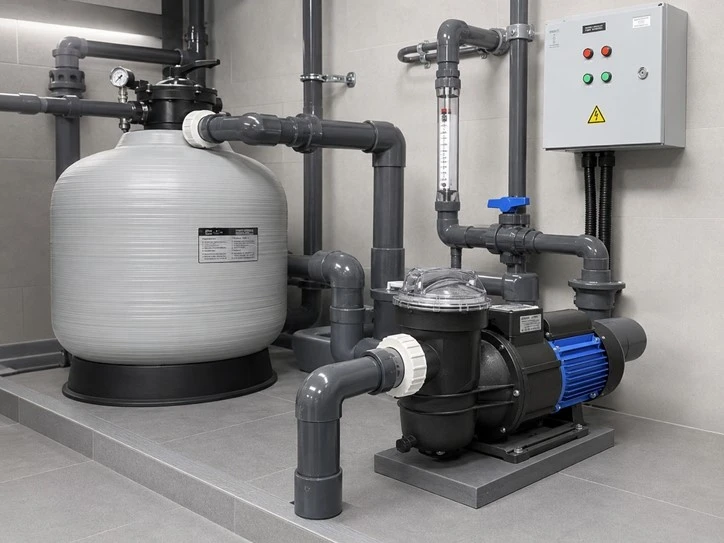
The pool pump itself does not remove dirt or salt from seawater. Its main function is to circulate water through the complete filtration system.
A typical circulation process is:
Pool suction inlet → Strainer basket → Pool pump → Filter → Water treatment equipment → Pool return inlet
The filter captures suspended particles such as sand, hair, leaves and other debris. The pump provides the flow and pressure required to move the water through the pipelines, filter and treatment equipment.
A normal pool filter does not remove dissolved salt. If desalination is required, specialized equipment such as a reverse osmosis system is needed.
For effective seawater filtration, the pool pump must maintain sufficient flow at the actual system head. The maximum flow shown on a pump label does not represent the real operating flow after the pump is connected to pipelines, valves and filters.
Before selecting a seawater filtration pump, the following information should be confirmed:
- Pool dimensions and total water volume

- Required water turnover time
- Required operating flow
- Estimated total head
- Pipeline diameter and length
- Filter type
- Pump installation position
- Seawater salinity
- Water temperature
- Voltage, phase and frequency
A properly selected pump should match the required operating point instead of simply using the highest available horsepower.
What Should You Look for in a Seawater Pool Pump?
The most important factor is the material configuration of the components in contact with the water.
The pump housing, impeller, diffuser, shaft area, fasteners and mechanical seal should all be suitable for saline water. Engineering plastics and selected corrosion-resistant materials are often used to reduce direct metal exposure.
The mechanical seal is particularly important. An unsuitable seal may wear or leak prematurely under high-salinity conditions. Its configuration should be selected according to the salinity, water temperature, operating time and chemicals used in the pool.
A built-in strainer basket is also valuable for seawater pool systems. Natural seawater may contain sand, small shells, leaves and organic debris. The strainer basket helps prevent larger particles from entering the impeller and causing blockage.
For installations where the pump is positioned above the pool water level, a self-priming structure can make startup and daily operation easier. However, self-priming does not mean that the pump can operate without water. The pump casing must be filled before startup, and the suction pipeline must remain airtight.
MISLIER STP Series for Seawater Pool Applications
For projects using natural seawater or operating under higher-salinity conditions, MISLIER can provide the STP Series pool pump with a seawater-standard configuration.
The seawater-standard version is designed for applications where the material configuration of an ordinary pool pump may not provide sufficient corrosion resistance.
The STP Series combines a self-priming structure with an integrated strainer basket, making it suitable for circulating water through pool filters and treatment systems.
Typical applications include:
- Seawater swimming pools
- Seaside hotel pools
- Coastal resort pools
- Marine leisure facilities
- Oceanfront villas
- Aquaculture circulation systems
- Seafood holding tanks
- Marine display pools
- Other saline water filtration systems
Different STP models can be selected according to the required flow, total head, pool volume and electrical supply.
Instead of recommending a pump only according to horsepower, MISLIER evaluates the actual operating conditions before model selection. Customers can provide the pool volume, required flow, total head, salinity, temperature, filter type and voltage information. A suitable STP model can then be matched to the actual filtration system.
This approach helps avoid both oversizing and undersizing. An oversized pump may increase electricity consumption, filter pressure and pipeline velocity, while an undersized pump may fail to complete the required water turnover.
Installation and Maintenance Recommendations
Even a seawater-standard pump requires correct installation and regular maintenance.
The suction pipeline should be as short and direct as possible. Excessive bends, undersized pipes and high suction lifts should be avoided. All suction-side connections must remain airtight, as air leakage may cause difficult priming and unstable flow.
Before startup, the pump casing should be filled with water, and all necessary valves should be opened. Dry running may damage the mechanical seal.
Routine maintenance should include:
- Cleaning the strainer basket
- Checking filter pressure
- Cleaning or backwashing the filter
- Inspecting the mechanical seal area
- Removing external salt deposits
- Checking electrical terminals and fasteners
- Inspecting the impeller when flow decreases
- Maintaining balanced pool water chemistry
Regular inspection can reduce unexpected downtime and extend the service life of the complete circulation system.
faq
Can a standard pool pump be used for seawater?
Is every saltwater pool pump suitable for natural seawater?
Is every saltwater pool pump suitable for natural seawater?
No. Many saltwater pool pumps are designed for lower salt concentrations used with salt chlorine generators. Natural seawater requires a more corrosion-resistant configuration.
Can a pool pump remove salt from seawater?
How should the correct pump size be selected?
How should the correct pump size be selected?
The pump should be selected according to the required flow at the actual total head. Pool volume, turnover time, pipeline resistance and filter pressure loss should all be considered.
How can I select the right MISLIER STP model?
Provide the pool volume, required flow, total head, seawater salinity, water temperature, filter type, installation position and electrical supply. MISLIER can then recommend a suitable STP seawater-standard pool pump.
A More Reliable Solution for Seawater Filtration
A seawater pool requires more than a standard circulation pump with sufficient motor power. Salinity, material compatibility, mechanical seal design and actual hydraulic performance must all be considered.
Choosing a dedicated seawater pool pump can reduce corrosion risk, improve circulation stability and lower the possibility of premature equipment replacement.
For seaside hotels, coastal villas, resorts, marine facilities and other saline water applications, the MISLIER STP Series is available with a seawater-standard configuration.
Send us your pool volume, required flow, total head, salinity and power supply information. Our team will help you select a suitable STP pump for your seawater filtration system.