


An end suction pump and a horizontal multistage pump can both move clean water, but they are usually selected for different jobs.
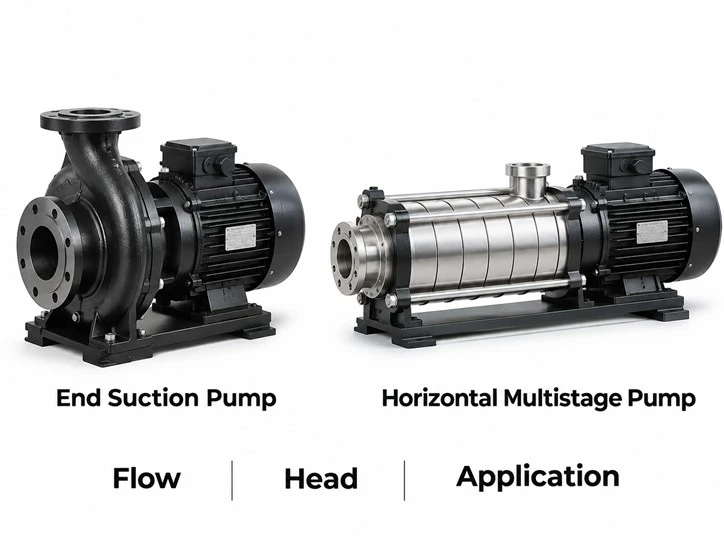
From the outside, the difference is easy to see. An end suction pump normally has one impeller and a simpler pump body. A horizontal multistage pump has several impellers arranged in series inside one casing.
The more important difference is what happens at the duty point.
One pump is usually better suited to larger flow with moderate head. The other is used when the system needs more pressure.
That sounds simple, but in actual inquiries the choice is not always obvious.
We often receive pump requests that only include motor power or pipe size. Sometimes a customer asks for a 5.5 kW pump and expects us to decide the model from that information alone.
That is not enough.
For either type, we first need flow and head.
Where an End Suction Pump Usually Fits
An end suction centrifugal pump is common in industrial water transfer, cooling circulation, tank-to-tank transfer and general utility systems.
Its structure is relatively simple. Water enters through the suction port at the front of the pump and leaves through the discharge connection after passing through the impeller.
In many systems, one impeller is enough.
Suppose a factory needs to circulate cooling water at a relatively high flow but the total system resistance is not very high. There may be no reason to use several stages.
A single-stage end suction design is often easier to install and easier to service.
That matters on site.
If the pump is used in a plant where maintenance staff already handle standard centrifugal pumps, the familiar structure can be an advantage.
The pump does not need to be complicated if the system does not need high pressure.
This is one reason end suction pumps are still widely used even though multistage pumps can reach much higher heads.
Higher head is not automatically better.
The pump only needs to meet the real system requirement.
A Horizontal Multistage Pump Is Mainly About Pressure
A horizontal multistage pump works differently.
Instead of relying on one impeller, it uses several stages. Each stage adds more head as the water passes through the pump.
This makes the design useful for applications such as pressure boosting, boiler feed, water treatment equipment and systems with a long discharge line or higher static lift.
The flow may be similar to an end suction pump, but the required head can be much higher.
This is where buyers sometimes compare the two incorrectly.
They look at two pumps with the same motor power and assume they should have similar performance.
That is not necessarily true.
A 4 kW end suction pump may be designed for a larger flow at moderate head.
A 4 kW multistage pump may deliver less flow but considerably more head.
The motor size alone does not tell us which pump is suitable.
The performance curve does.
The System Usually Makes the Decision
A useful way to compare the two is to forget the pump type for a moment and look at the system.
How much water is needed?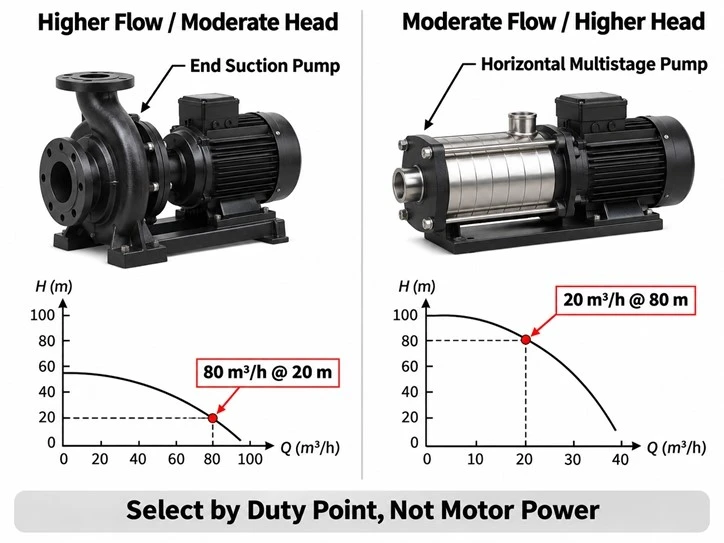
How much resistance does the water have to overcome?
If the system needs 80 m³/h at 20 m head, a single-stage end suction pump may be a very reasonable choice.
If the requirement is 20 m³/h at 80 m head, a horizontal multistage pump becomes much more likely.
Those numbers are only examples, but the logic is the same.
The pump must operate close to the required flow and head at the same time.
Maximum flow and maximum head should not be read separately from a catalogue and combined as if they occur at one operating point.
They usually do not.
This is something we often have to explain when replacing an old pump.
A customer may send a nameplate showing maximum head and motor power but no performance curve. In that case, we still try to find the actual operating duty before choosing a replacement.
If the old pump was oversized, repeating the same type may repeat the same problem.
Suction Conditions Can Favor the Simpler Pump
The suction side also deserves attention.
End suction pumps are often installed close to a tank, basin or open water source. If the suction pipe is short and properly sized, the arrangement is straightforward.
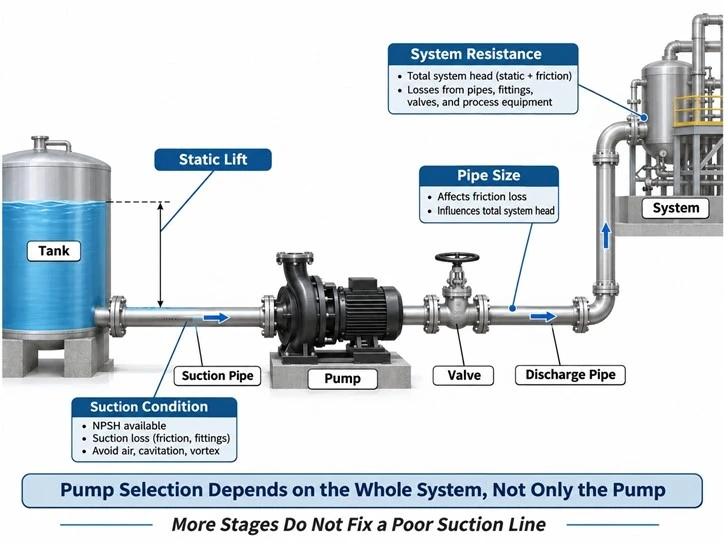
But if the pump is installed above the water level, or if the suction line is long, narrow or full of fittings, the actual suction condition becomes more important.
A multistage pump is not a way to fix a poor suction line.
Adding stages increases discharge head. It does not automatically improve the pump's ability to draw water from a difficult suction arrangement.
If the inlet condition is poor, either pump type can have problems.
Cavitation, unstable flow and noise may appear even when the selected motor power looks correct.
This is why we still ask about tank level and suction arrangement on some projects.
The discharge side tells us how much head the pump needs.
The suction side tells us whether the pump can receive water properly.
Both matter.
Maintenance Is Different Too
The simpler construction of an end suction pump is useful where easy maintenance is important.
There is one impeller, a relatively straightforward casing and fewer internal hydraulic stages.
For many factories, that means inspection and repair are familiar.
A multistage pump has more internal components.
That is not a disadvantage by itself. It is simply a different design for a different job.
If the system needs 100 m of head, the extra stages are doing useful work.
If the system only needs 20 m, those stages may add cost and complexity without giving the customer anything useful.
This is why we do not like selecting a pump by saying one type is "better."
Better for what?
That is the real question.
What About Installation Space?
Horizontal multistage pumps can be quite compact for the amount of pressure they produce.
That can be useful when a customer needs high head but has limited vertical space.
An end suction pump may use more width around the pump and pipe connections, depending on the design and motor size.
But installation space should not be judged only by the dimensions of the pump body.
The suction pipe needs a sensible route.
The discharge pipe needs support.
Valves need space.
The motor and mechanical seal area should remain accessible for maintenance.
A pump that fits into the available space on paper can still be difficult to service after installation.
This is particularly important on replacement projects where the new pump has to fit existing pipework.
Changing from one pump type to another may require pipe modification, even if the hydraulic duty is correct.
Which One Would We Check First?
For larger flow and moderate head, we would usually check an end suction centrifugal pump first.
For higher pressure at moderate flow, a horizontal multistage pump is often the more natural starting point.
But there are overlaps.
Two different pump types may both be capable of reaching the same duty point.
When that happens, the decision can come down to efficiency, installation space, maintenance preference, material requirement and price.
That is why a catalogue comparison alone is not always enough.
For a first selection, we normally need:
- required flow
- required head
- liquid type
- liquid temperature
- voltage and frequency
- suction condition
- pipe connection size if fixed
- material requirement
- quantity
For a replacement, the old pump model and a photo of the nameplate are also useful.
If the existing system has been working well, the old pump gives us a useful reference.
If it has not been working well, then we should not assume the same hydraulic selection should be copied.
Selecting the Pump with MISLIER
Shanghai Mislier Pump Industry Co., Ltd. supplies horizontal pumps for industrial water transfer, cooling circulation, pressure boosting and water-treatment systems.
When comparing an end suction pump with a horizontal multistage pump, we normally start with the required operating point rather than the motor power or pump appearance.
You can view our horizontal pump range if you already know the main operating parameters.
If you are replacing an existing pump or are not sure which structure is more suitable, send us your pump requirements.
Flow, head, liquid, temperature, voltage and frequency are usually enough for the first check. If you also have the old nameplate, performance curve or installation photo, send those as well.
That gives us a better basis for deciding whether a single-stage end suction design or a horizontal multistage pump makes more sense for the system.