


When buyers compare swimming pool pumps, they often look at horsepower first, then maximum flow. These two numbers are easy to understand, but they do not always tell the real performance of a pump after installation. In a pool system, the pump is not just pushing water in open air. It has to move water through suction pipes, elbows, valves, a filter, return pipes and sometimes other equipment such as heaters or chlorinators.
This is why head and flow must be checked together. Flow shows how much water the pump can move. Head shows how much resistance the pump can overcome while moving that water. A pump may have a high maximum flow on the catalog page, but that value is usually measured under low-resistance conditions. Once the pump is connected to a real pool system, the actual flow will change.
For buyers, this point is important. A pump that looks strong by HP may still give weak return water if the working head is high. Another pump may seem smaller, but if its curve matches the real system better, it can run more stable. Good pump selection is not about choosing the biggest number. It is about finding the model that can deliver the required flow at the actual working head.

Flow Is Not Fixed, It Changes with Head
Flow rate is normally shown in m³/h, L/min or GPM. For pool circulation, buyers usually calculate the required flow according to pool volume and turnover time. For example, a 60 m³ pool that needs one full circulation in 6 hours requires about 10 m³/h. This gives the basic flow target.
But the pump will not always deliver this flow in every system. Head is the reason. In many pool projects, head is misunderstood as only vertical lifting height. In fact, for a swimming pool circulation system, head mainly comes from total resistance: pipe friction, filter resistance, valve loss, elbows, pipe diameter, suction condition and return line layout. Even if the pump and pool are almost on the same level, the system can still have considerable head loss.
The relationship is simple: when head increases, flow decreases. A pool pump may deliver 18 m³/h at low head, but only 12 m³/h when the system resistance becomes higher. This does not mean the pump is defective. It is the normal relationship between head and flow. The question is whether the pump can still meet the required flow at the real working condition.
This is where many wrong selections happen. Some buyers only read the maximum flow and assume the pump is large enough. After installation, the return jet is weak, the pool takes too long to circulate, or the water stays cloudy. The real issue may be that the pump was not selected according to the actual head.
Reading the Pump Curve Is More Useful Than Comparing HP
A pump curve shows how the pump performs under different heads. On most pump curves, the horizontal axis is flow, and the vertical axis is head. The curve lets buyers see what flow the pump can provide at a certain head. This is much more useful than looking only at HP.
 For example, two pumps may both be marked as 1.5 HP, but one may provide better flow at 8 meters head, while the other may perform better at 12 meters head. If the buyer only compares HP, both pumps look similar. But in a real pool system, their performance can be different.
The most important point on the curve is the duty point, also called the operating point. This is the point where the pump performance meets the system resistance. In practical terms, it is the real flow and head that the pump will reach after installation. A pump is suitable only when this point is close to the required flow range of the pool and also acceptable for the filter system.
For factory selection work, this is one of the key details. A supplier should not simply say "this pump is 1 HP" or "this pump is 1.5 HP." The better way is to check the buyer's pool volume, required flow, pipe size, filter model and installation distance, then compare them with the pump curve. This is how technical selection reduces after-sales problems.
Where Head Loss Comes from in a Pool System
In a real pool project, head loss often comes from several small details added together. A long suction pipe may reduce the water reaching the pump. A small pipe diameter may increase friction. Too many elbows or narrow fittings can make the pump work harder. A filter that is too small or too dirty can raise pressure and lower actual flow.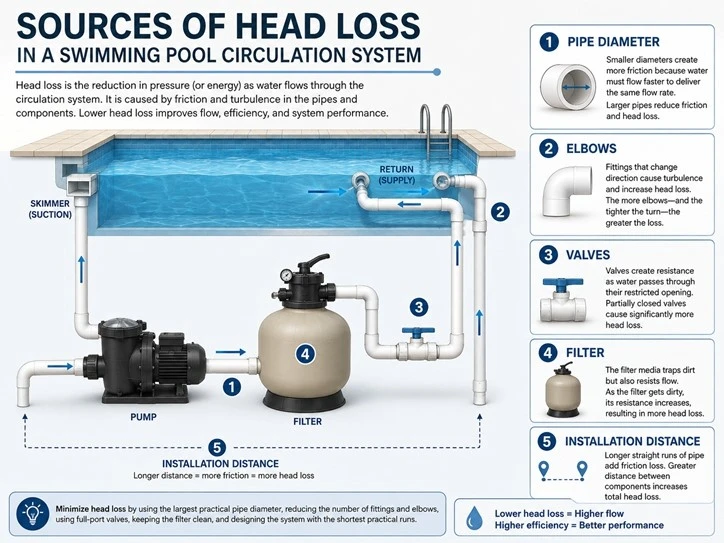
The filter condition is especially important. When a sand filter or cartridge filter is clean, the resistance is lower. After running for some time, dirt builds up and the pressure rises. As resistance increases, the pump may deliver less flow than before. This is why a pool system may work well after cleaning, but gradually show weaker circulation later.
Pipe layout also has a clear influence. Straight, properly sized pipes usually help the pump run more efficiently. Long lines, tight bends, poor valve positions or undersized connections can reduce flow and increase noise. In hotel pools, villa pools and commercial pool projects, these installation details are more important because the system often runs for long hours every day.
The pump, filter and pipe system should always be viewed as one complete circulation system. If the pump is too strong for the filter, the pressure may become high and filtration may become unstable. If the pump is too weak for the pipe resistance, the flow may not be enough. A balanced system gives better water circulation, lower noise and fewer maintenance complaints.
What Buyers Should Check Before Choosing a Model
Before confirming a pool pump model, buyers should prepare several basic details: pool volume, expected turnover time, required flow rate, pipe diameter, suction distance, return pipe layout, filter model, filter recommended flow, estimated working head, voltage and  frequency. These details are usually enough for a supplier to make a much more accurate recommendation than selecting only by HP.
For replacement projects, photos are very useful. A clear nameplate photo, filter label, pipe layout photo and equipment room photo can show many details that are not easy to describe in words. If the old system has problems such as weak flow, high pressure, loud noise or cloudy water, the supplier should know this before recommending the replacement pump.
Buyers should also separate maximum flow from working flow. Maximum flow is only a reference. The real concern is whether the pump can deliver the required flow at the expected head. If a supplier can explain the pump curve and match it with the filter and pipe system, the selection is usually more reliable.
For export orders, voltage and frequency must also be confirmed. Different markets may require 220V/50Hz, 230V/50Hz, 110V/60Hz or 220V/60Hz. A hydraulically suitable pump can still become a problem if the electrical specification is wrong.
Conclusion
Pool pump head and flow are not separate numbers. Flow tells how much water the pump can move, while head tells the resistance the pump must overcome. In a real swimming pool system, actual performance depends on the balance between the two.
The best pump is not always the model with the highest HP, the largest maximum flow or the highest head. The best choice is the pump that can deliver the required flow at the actual working head, while matching the filter, pipework and installation conditions.
For buyers, understanding head and flow makes pump selection more accurate. For distributors and contractors, it also makes communication with customers more professional. A supplier with real technical selection ability can help reduce wrong models, pressure problems, weak circulation and after-sales complaints.
Looking for a reliable swimming pool pump supplier? Contact us for suitable pool pump solutions, head and flow selection support, competitive factory pricing and stable supply for your market.