


If you are choosing a booster pump, we recommend looking beyond the purchase price. Pressure stability, part-load operation, electrical compatibility and access for maintenance all affect how the system works over time. Here, we explain the differences so you can assess which solution fits your project and what information to prepare for a quotation.
What is a VFD pump
When we refer to a VFD pump, we mean a pump whose compatible motor is controlled by a variable frequency drive. The drive changes the electrical supply frequency to adjust motor speed within the approved range. Depending on the product configuration, the drive may be integrated into the pump or installed separately.
For a constant-pressure booster system, we look at the complete control arrangement. A pressure sensor sends feedback to the controller, which adjusts speed as demand changes to help maintain the setpoint. Correct sizing, sensor placement, settings and pipework are essential. Adding a drive alone does not guarantee constant pressure.
We also distinguish variable-speed control from permanent magnet motor technology. They are separate features: a VFD pump does not automatically use a permanent magnet motor. Before selecting a system, we check the specifications and compatibility of the motor and drive.
What is a fixed speed pump
A fixed speed pump runs at approximately one motor speed when switched on. We sometimes see confusion between fixed speed and fixed flow, but they are different. Actual flow depends on where the pump curve meets the system curve, so changes in pipe resistance, valve opening or operating conditions can move the duty point.
For a relatively stable duty, we would evaluate a correctly sized fixed speed pump alongside the available alternatives. Pressure switches, pressure tanks or other system controls can regulate its operation. A simpler control arrangement may be appropriate when the system does not need frequent speed adjustment.
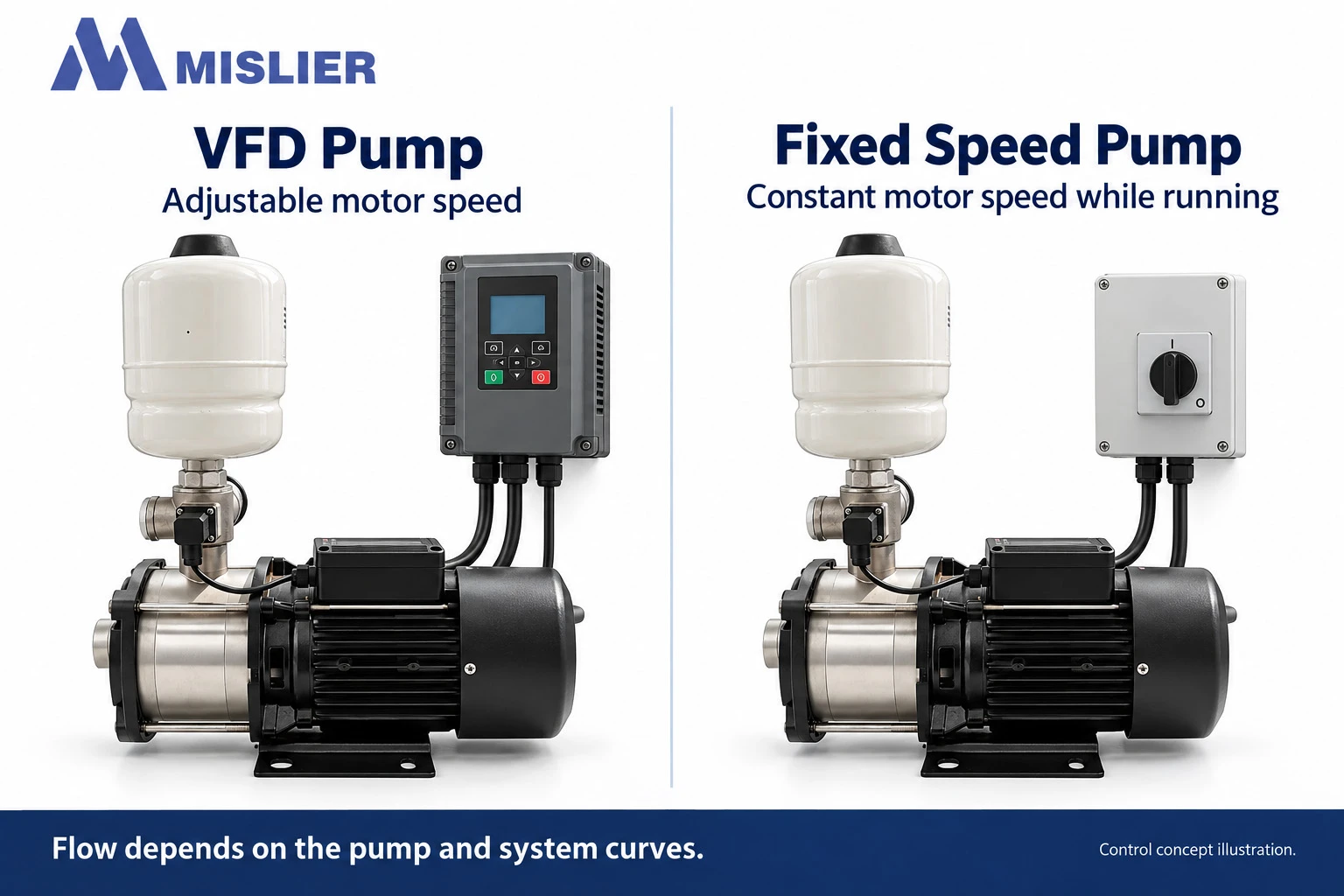
VFD pump vs fixed speed pump comparison
|
Feature |
VFD pump |
Fixed speed pump |
|
Speed control |
Adjustable within approved limits |
Largely constant while running |
|
Pressure control |
Feedback control can regulate a pressure setpoint |
Typically uses switching, tanks or other system controls |
|
Initial cost |
Often higher with drive and controls |
Often lower with simpler controls |
|
Energy use |
Potential benefit with variable demand; system dependent |
Can be efficient at a well-matched stable duty |
|
Installation |
Drive settings and motor compatibility need attention |
Electrical controls are usually simpler |
|
Best fit |
Changing flow or pressure requirements |
Relatively stable operating requirements |
When can a VFD pump save energy
When comparing a VFD pump vs fixed speed pump for energy use, we first consider how much time the system spends below its maximum design demand. In suitable systems, reducing speed can avoid some losses associated with throttling or bypassing flow. The benefit depends on the demand profile, static head, friction losses and the efficiency of the pump, motor and drive.
For an initial technical assessment, centrifugal-pump affinity laws can help explain the effect of speed changes. Under similar conditions, flow is approximately proportional to speed, head to speed squared and power to speed cubed. We would not use these relationships alone to promise electricity savings in an installed system. Static head, changing efficiency and operating limits also matter, particularly when comparing high-static-head and friction-dominated systems.
Our recommendation is to compare annual input energy at representative operating points, rather than motor nameplate power alone. Include your electricity tariff, operating hours, equipment cost and maintenance requirements. We do not apply a single energy-saving percentage to every VFD installation.

Pressure control and starting behavior
If your demand changes throughout the day, we would assess whether speed adjustment can provide a better match than relying entirely on repeated starts and stops. Many drives also offer controlled acceleration, which may reduce abrupt starting effects. The actual result depends on the selected drive, motor and hydraulic system.
We treat water hammer and frequent cycling as system-design questions, not issues that a VFD automatically solves. A pressure tank, appropriate valves, suitable pipe sizing and correct settings may still be needed. A properly configured fixed speed system can also provide dependable supply.
Selecting a MISLIER booster pump
If you are considering our APG series for domestic or commercial constant-pressure water supply and boosting, we can discuss the available model specifications with you. We recommend selecting against the performance curve and checking the electrical supply and operating limits of the particular model, rather than choosing by motor power alone.
To help us assess your project, send your required flow rate, total head or target outlet pressure, inlet pressure or suction conditions, liquid and temperature, voltage, phase and frequency. Please also include daily operating hours, quantity and delivery destination. If your system has several duty points, share the expected demand range.
Not sure how to describe your duty point? Send us the information you have about the application and installation. We can discuss the specifications needed for model selection and prepare a quotation based on your requirements.
FAQ
Q:A: Can every fixed speed pump be converted to VFD operation?
No. Before recommending a conversion, we would need to check motor compatibility, cooling at reduced speed, approved speed limits, drive output characteristics and manufacturer guidance.
Q:A: Is a fixed speed pump always the cheaper option?
Its purchase price is often lower, but we recommend comparing electricity, control equipment, maintenance and operating hours to understand the overall cost.
Q:
A: Does variable speed mean constant pressure? No. We look for suitable sensing, feedback control and system design. Variable speed provides a way to control output; it does not guarantee a particular pressure result.
Q:
A: Does a VFD pump always use less electricity? No. We assess the operating profile and system conditions before discussing energy performance. The useful comparison is input energy at the duties your system actually needs.
Q:
A: Can every fixed speed pump be converted to VFD operation? No. Before recommending a conversion, we would need to check motor compatibility, cooling at reduced speed, approved speed limits, drive output characteristics and manufacturer guidance.
Q:
A: Is a fixed speed pump always the cheaper option? Its purchase price is often lower, but we recommend comparing electricity, control equipment, maintenance and operating hours to understand the overall cost.
Q:
A: Does variable speed mean constant pressure? No. We look for suitable sensing, feedback control and system design. Variable speed provides a way to control output; it does not guarantee a particular pressure result.