


When wastewater cannot reach the main sewer by gravity, a lifting station collects it and pumps it to a higher discharge point. For a basement bathroom located only a few metres below the sewer, a standard system may be sufficient. The situation changes when the discharge route rises higher, runs farther or connects to a pressurised main. In these cases, a high pressure sewage lift station may be required.
"High pressure" does not simply mean installing a larger motor. In engineering terms, the real question is whether the pump can provide the required flow while overcoming the total resistance of the discharge system. That resistance is normally expressed as total dynamic head, or TDH.
What Does High Pressure Mean in a Sewage Lift Station
A sewage lifting system does not create pressure for its own sake. It produces enough head to move wastewater from the collection tank to the final discharge point at the required flow rate.
The pump must overcome several forms of resistance:
- The vertical height between the operating water level and the discharge point
- Friction inside the discharge pipe
- Resistance through bends, valves and fittings
- Pressure already present at the connection point
- Changes in pipe diameter or pipe material
This is why two projects with the same vertical lift may require different pumps. A short, direct pipe with few fittings creates less resistance than a long route containing several elbows, valves and narrow sections.
The term "high pressure" should therefore be understood as a relatively high total head requirement. There is no single head value that automatically makes every system a high-pressure installation. The decision depends on the complete pipe network and the required flow.
When Is a Higher Head System Required
One of the clearest warning signs is a large vertical difference between the collection tank and the sewer connection. This is common in deep basements, underground commercial areas and buildings constructed on sloping ground. The greater the elevation difference, the more head the pump must generate before wastewater begins moving through the system.
A long discharge pipe can create another problem. Horizontal distance does not convert directly into vertical head, but every metre of pipe adds friction. The effect becomes more noticeable when the pipe diameter is small, the required flow is high or the route contains many fittings.
Connection to a pressurised sewer is another situation requiring careful assessment. The pump must not only lift the wastewater and overcome pipe friction; it must also work against the pressure at the discharge point. If that back pressure is omitted from the calculation, the selected pump may deliver far less flow than expected.
Projects with several of these conditions at the same time deserve particular attention. A moderate vertical lift combined with a long, narrow pipeline and a pressurised outlet can be more demanding than a taller but shorter installation.
Common applications that may require a higher-head system include:
- Deep basement bathrooms and sanitary rooms
- Hotels with remote underground equipment rooms
- Commercial buildings with long internal discharge routes
- Buildings located below the municipal sewer
- Villas and developments built on sloping land
- Remote facilities connected through a long pressure pipe
- Renovation projects with limited options for pipe routing
These examples do not mean that every basement, hotel or sloping site needs the same pump. They indicate that the complete operating conditions should be calculated before the equipment is selected.
Why a Standard Lift Station May Not Be Enough
A pump can run normally and still fail to provide the required system performance. If the actual total head is higher than the pump was selected for, the operating point moves along the pump curve and the delivered flow usually falls.
The collection tank may then take longer to empty. During periods of high inflow, the wastewater level can continue rising even though the pump is running. This may lead to long operating periods, frequent high-level alarms or an inability to keep up with peak demand.
Low flow in the pressure pipe can also affect solids transport. Sewage may remain in the line for longer, while material can settle in sections where the pipe velocity is insufficient. On the other hand, selecting a pump that is far too large may produce excessive velocity, noise, hydraulic shock and unnecessary starting and stopping.
These problems cannot be solved reliably by comparing motor power alone. A 2.2 kW pump is not automatically suitable because another 1.5 kW pump failed. The two pumps may have different hydraulic designs, performance curves and efficient operating ranges.
Calculate Total Dynamic Head Before Selecting the Pump
A practical selection starts with total dynamic head: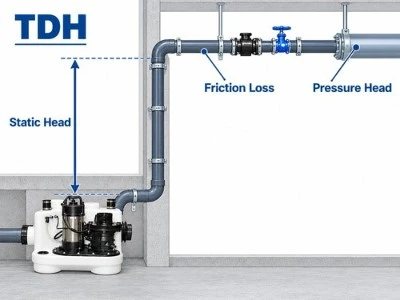
Total Dynamic Head = Static Head + Friction Loss + Pressure Head
Static head is the vertical elevation difference the pump must overcome. It should be measured from the relevant operating liquid level in the tank to the appropriate discharge point, rather than from the floor or the bottom of the unit.
Friction loss depends on the flow rate, internal pipe diameter, total pipe length, pipe material and number of fittings. A check valve, isolation valve, tee or elbow contributes additional resistance. These losses should be calculated for the intended operating flow, because friction increases as flow rises.
Pressure head applies when the system discharges into a pipe that is already under pressure. The existing pressure must be converted into head and added to the calculation.
The resulting TDH is not enough on its own. It must be considered together with the required flow. These two values form the duty point used to check the pump performance curve.
Why a Larger Motor Is Not Always the Answer
The correct high pressure sewage lif t station must be selected from its pump curve, not from its maximum head or motor rating alone.
Maximum head is normally reached at or near zero flow. It does not describe the amount of wastewater the pump can deliver under real operating conditions. A product advertised with a high maximum head may provide much less flow at the project duty point.
The selected duty point should fall within a suitable part of the performance curve. If it sits too close to either end, the pump may operate inefficiently or become sensitive to small changes in the system.
Pipe diameter also needs to be coordinated with the pump. Reducing the pipe size may lower installation cost, but it increases velocity and friction loss. The result can be a higher required head and greater energy consumption throughout the life of the system.
For this reason, pump selection and pipe design should be reviewed together. Changing the pipe length, diameter or routing after selecting the pump can move the real operating point away from the original design.
Installation Details That Affect Performance
Even a correctly selected pump can perform poorly if the discharge pipe is installed incorrectly. Unnecessary bends, partially closed valves and undersized sections increase system resistance. Long horizontal runs should be properly supported, and the pipe pressure rating must suit the maximum operating and transient pressure.
A check valve is generally used to prevent wastewater from returning to the tank after the pump stops. An isolation valve allows the pump or check valve to be serviced without draining the complete pipe system. Both should remain accessible after installation.
The layout should also provide enough space to remove the pump, disconnect pipework and inspect the tank. Concealing the complete station behind a permanent wall may save space initially, but it can make later service unnecessarily difficult.
The control system should match the application as well. Level control, high-level alarm and suitable motor protection help the operator identify abnormal conditions, but they cannot compensate for an incorrectly selected hydraulic duty point.
Information to Prepare Before Requesting a Selection
Before asking a supplier to recommend a station, prepare the following project information:
- Required or estimated peak wastewater flow
- Vertical distance from the operating level to the discharge point
- Total length of the discharge pipe
- Pipe material and internal diameter
- Number of bends, tees, valves and other fittings
- Pressure at the final connection point, if applicable
- Wastewater source and expected solids
- Available voltage, phase and frequency
- Installation space and maintenance access
- Expected operating pattern
Photos, a simple pipe sketch and elevation information are often more useful than a general request for a "high-pressure pump." They allow the supplier to estimate the system curve and check whether the proposed pump can reach the required duty point.
Final Recommendation
A higher-head system should be considered when wastewater must travel through a substantial vertical lift, a long or restrictive pressure pipe, or into a discharge point with existing back pressure. However, the phrase "high pressure" should never replace an actual calculation.
Start with the required flow, calculate the total dynamic head and then check where the duty point falls on the pump curve. This approach gives a much clearer answer than comparing tank volume, maximum head or motor power separately.
MISLIER offers external sewage lifting systems for residential and commercial wastewater projects. You can review our high pressure external sewer lift pump station to understand the available configuration and performance range.
If you are unsure whether your project requires a high pressure sewage lift station, send us the required flow, vertical lift, pipe length, pipe diameter, wastewater type and power supply. Our team can review the operating conditions and recommend a suitable pump and station configuration. For technical support, product information or a quotation, please contact MISLIER.