


Vertical pumps are widely used in industrial water supply, building pressure boosting, water treatment, HVAC systems, agricultural irrigation, industrial drainage, and many other fluid-handling applications. However, when it comes to actual pump selection, the term "vertical pump" does not refer to one specific pump design.
A vertical inline pump, vertical multistage pump, vertical turbine pump, vertical sump pump, and even certain types of submersible pumps may all fall under the broader category of vertical pumps.
This is also where many buyers become confused.
These pumps may all have a vertical configuration, but their hydraulic design, suction arrangement, head range, installation method, and suitable liquids can be very different. For example, vertical multistage centrifugal pumps are commonly used for pressure boosting in high-rise buildings, while a vertical turbine pump may be a better choice for deep-well water supply. For drainage from an industrial sump or tank, a vertical sump pump may be more suitable.
In other words, simply telling a supplier that you need "a vertical pump" is usually not enough for accurate selection.
Understanding the different types of vertical pumps, how they work, and where they are used is much more useful than comparing motor power, flange size, or price alone.
What Is a Vertical Pump?
A vertical pump is generally a pump in which the shaft, motor, and main pumping components are arranged in a vertical direction.
Compared with many horizontal pump designs, vertical pumps normally require less floor space. Depending on the construction, they can also be adapted for direct pipeline installation, deep-well water extraction, sump drainage, high-pressure boosting, cooling-water circulation, and many industrial processes.
However, "vertical" mainly describes the orientation and installation arrangement of the pump. It does not completely define its hydraulic design.
For example, a vertical inline centrifugal pump may use only one impeller, while a vertical multistage centrifugal pump can contain several or even more than ten impellers arranged in series. A vertical turbine pump normally has its bowl assembly below the water level while the motor remains above ground. A vertical sump pump also commonly keeps the motor above the liquid while the pump casing and shaft extend into the tank or sump.
For this reason, when discussing different vertical pump types, it is useful to consider three basic factors:
Hydraulic design, installation method, and liquid source.
Because vertical pumps are available in many different configurations, they can handle applications ranging from normal water circulation and high-pressure clean-water supply to industrial wastewater, cooling fluids, process liquids, and certain chemical solutions.
Buyers may search for types of vertical pumps, vertical pump types, or even the phrase vertical pumps types, but the real selection process should always start with the operating conditions rather than the product name alone.
Six Common Types of Vertical Pumps
There is no single classification system used by every pump manufacturer. However, from an industrial purchasing and application point of view, vertical pumps can generally be divided into six common groups.
1. Vertical Inline Pump
A vertical inline pump is one of the most common designs used in commercial buildings and industrial circulation systems.
Its most recognizable feature is that the suction and discharge connections are normally arranged in line with each other. This allows the pump to be installed directly into the piping system. The motor is mounted vertically above the pump casing, creating a compact installation compared with many traditional horizontal end-suction pumps.
Many single-stage vertical inline pumps use one impeller and are particularly suitable for medium-to-high flow with relatively low or moderate head requirements.
Typical applications include: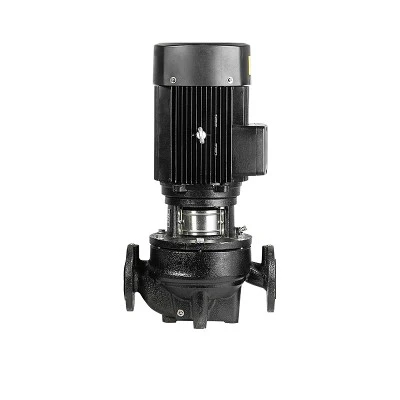
- Building water supply
- HVAC chilled-water circulation
- Cooling-water systems
- Industrial circulating water
- Cooling towers
- General clean-water transfer
- Some fire protection systems
The main advantage of a vertical inline pump is not extremely high discharge pressure. Its real strength is the combination of compact installation, simple piping arrangement, and reduced equipment-room footprint.
This makes it especially useful in mechanical rooms where available floor space is limited.
However, the piping system must be considered during installation. Pipe support, valve weight, pump casing stress, alignment, and maintenance access are all important.
The pump should not be expected to support the weight of the surrounding pipeline. Excessive piping load transferred to the pump flanges may contribute to vibration, mechanical seal problems, bearing wear, or alignment issues over long-term operation.
2. Vertical Multistage Pump
The vertical multistage pump is one of the most widely used vertical pump designs in commercial and industrial water systems. It is also one of our main product categories.
Unlike a single-stage pump, a vertical multistage pump uses several impellers arranged vertically in series.
Water passes through the first impeller and then continues into the next stage. Each stage adds energy to the liquid, allowing the pump to generate much higher discharge pressure within a relatively compact pump body.
This makes vertical multistage centrifugal pumps particularly suitable for applications requiring high head.

Common applications include:
- High-rise building pressure boosting
- Constant-pressure water supply systems
- Reverse osmosis systems
- Industrial water treatment
- High-pressure washing
- Boiler feed applications
- Filtration systems
- Cooling systems
- Production-line water supply
- OEM equipment
- Industrial booster systems
With the rapid development of AI infrastructure and large data centers, cooling and liquid-cooling systems are also becoming an increasingly important application area for water pumps. Depending on the specific cooling architecture, vertical multistage pumps can be used in secondary cooling-water circulation, pressure boosting, heat-exchange loops, and supporting water-treatment systems where stable flow and pressure are required.
Well-known product families such as Grundfos CR, KSB Movitec, Wilo MVI, and CNP CDLF are examples of vertical multistage centrifugal pump designs.
This type of pump is also commonly used as the core pump in variable-speed booster sets and constant-pressure water supply systems.
Compared with a typical single-stage vertical inline pump, the main advantage of a vertical multistage pump is its ability to produce higher head without requiring a very large installation footprint.
However, more stages do not automatically mean a better pump.
If a system requires very high flow but relatively low head, adding unnecessary stages provides little benefit. Standard vertical multistage pumps are also mainly designed for clean water or relatively clean process liquids.
If the liquid contains large amounts of sediment, fibers, suspended solids, or larger particles, another pump design may be more appropriate.
Therefore, when selecting a vertical multistage centrifugal pump, the first consideration should always be the actual flow and head duty point, rather than simply comparing the number of stages or motor power.
3. Vertical Turbine Pump
A vertical turbine pump is mainly used when the water source is located below the installation level or when water needs to be lifted from deep wells, reservoirs, rivers, tanks, or other large water sources.
A typical vertical turbine pump consists of a motor installed above ground, a vertical shaft system, column pipes, and a bowl assembly installed below the water level.
The impellers operate directly in the water. The liquid passes through one or more bowl stages and then travels upward through the column pipe before entering the discharge system.
Vertical turbine pumps can be designed as either single-stage or multistage pumps. When a higher head is required, additional bowl stages can be added.

Typical applications include:
- Deep-well water supply
- Municipal water systems
- Agricultural irrigation
- Industrial raw-water intake
- Power plant circulating water
- Desalination intake systems
- Fire water systems
- Reservoir pumping
- Large industrial water supply systems
One important advantage of this design is that the hydraulic components operate below the liquid level. This avoids many of the suction limitations associated with surface-mounted centrifugal pumps.
For projects with a deep underground water level or significant changes in water level, a vertical turbine pump can therefore be more suitable than a conventional surface pump.
However, installation requirements are also more demanding.
Well diameter, foundation design, shaft alignment, installation depth, water-level variation, and maintenance access all need to be considered.
For this reason, providing only flow, head, and motor power is normally not enough when requesting a vertical turbine pump quotation.
The supplier should also know the well depth, minimum water level, maximum water level, installation arrangement, discharge connection, and any dimensional restrictions.
4. Vertical Sump Pump
A vertical sump pump is mainly used for draining or transferring liquids from tanks, industrial sumps, underground pits, process vessels, and production equipment. It is also widely used for coolant circulation and liquid transfer in CNC machining systems.
One of the main differences between a vertical sump pump and a conventional submersible pump is the motor position.
In a typical vertical sump pump, the motor remains above the liquid level while the pump section and part of the shaft extend downward into the liquid.
This design is useful in industrial applications where fully immersing the motor is undesirable or unnecessary.
Vertical sump pumps can be manufactured with different materials, impeller designs, and shaft arrangements according to the pumped medium.
Some models are designed primarily for clean liquids, while certain non-clog vertical sump pumps can handle wastewater containing limited solids, particles, fibers, or industrial residues.

Common applications include:
- Industrial wastewater pits
- Chemical tanks
- Equipment drainage pits
- Cooling-liquid circulation
- CNC machine tool coolant systems
- Metalworking fluids
- Wastewater collection
- Industrial process drainage
One especially important parameter when selecting this type of pump is immersion depth.
For example, two vertical sump pumps may have exactly the same flow and head requirements, but if one pump requires a 1-meter immersion depth and the other requires 3 meters, the shaft arrangement, support structure, bearing design, and manufacturing cost can be significantly different.
The liquid properties are also important.
The buyer should confirm whether the medium is corrosive, whether it contains solids, and the actual operating temperature.
For corrosive liquids, SS304 may not always be sufficient. Depending on the chemical composition and concentration, SS316, duplex stainless steel, or other corrosion-resistant materials may be required.
5. Vertical Submersible Pump
Submersible pumps are normally treated as a separate pump category, but they are frequently included in broader discussions about the types of vertical pumps.
Depending on the power source and application, submersible pumps can also be supplied in conventional electric versions or solar-powered configurations, especially for agricultural irrigation and remote water supply.
Unlike a vertical sump pump, both the motor and hydraulic section of a submersible pump are designed to operate while submerged in the liquid.
This eliminates the need for a long drive shaft between an above-water motor and the pump impeller.
Typical applications include:
- Building drainage
- Basement drainage
- Wastewater treatment
- Sump drainage
- Municipal sewage systems
- Construction dewatering
- Agricultural irrigation
- Deep-well water supply
When the pumped medium is wastewater, the category needs to be divided further.
A conventional sewage pump, non-clog pump, grinder pump, and cutter pump may all look relatively similar from the outside, but their impeller and inlet designs can be very different.
Their ability to handle solids, fibers, wipes, or other debris is therefore not the same.
This is why two pumps should not be considered interchangeable simply because they are both described as "vertical" or "submersible."
For example, a submersible well pump designed for clean groundwater is fundamentally different from a submersible sewage pump designed for domestic or municipal wastewater. Their hydraulic passages, motor construction, solids-handling capability, and overall design objectives are different.
6. Vertical Axial Flow and Mixed Flow Pump
For extremely high-flow applications, vertical axial flow pumps and vertical mixed flow pumps are another important group.
An axial flow pump moves liquid mainly in the direction of the pump shaft. It is generally used when the required flow is very high but the required head is relatively low.
A mixed flow pump combines both axial and radial flow characteristics. As a result, it can provide a different balance between flow capacity and discharge head.
These pumps are not normally used for small building booster systems. They are more commonly found in major water infrastructure and large industrial projects.

Typical applications include:
- Flood control
- Agricultural irrigation
- Drainage stations
- Large water conservancy projects
- Municipal stormwater pumping stations
- Industrial cooling-water systems
- River water intake
- Large-scale water transfer
When a project requires several thousand or even tens of thousands of cubic meters of water per hour but only a relatively low operating head, a conventional vertical multistage centrifugal pump would normally not be an efficient solution.
In these conditions, axial flow or mixed flow technology can be much more suitable.
Vertical Pump Types Comparison
Comparing the most common vertical pump types side by side makes their differences easier to understand.
|
Pump Type |
Main Design Feature |
Typical Flow and Head Range |
Common Applications |
|
Vertical Inline Pump |
Suction and discharge are normally arranged in line |
Medium to high flow, low to medium head |
HVAC, circulating water, building water supply |
|
Vertical Multistage Pump |
Multiple impellers operating in series |
Low to medium flow, high head |
Pressure boosting, RO, boiler feed, water treatment |
|
Vertical Turbine Pump |
Bowl assembly below water with vertical shaft |
Medium to high flow, medium to high head |
Deep wells, irrigation, raw-water intake, municipal water |
|
Vertical Sump Pump |
Motor above liquid with pump section submerged |
Varies according to design |
Industrial sumps, wastewater, coolant, CNC machines |
|
Vertical Submersible Pump |
Motor and hydraulic section fully submerged |
Wide operating range |
Irrigation, drainage, sewage, deep wells |
|
Vertical Axial or Mixed Flow Pump |
Designed primarily for large-volume water transfer |
Very high flow, low to medium head |
Flood control, irrigation, large intake systems |
This comparison also explains why a search such as "what are the different types of vertical pumps" cannot be answered simply by listing product names.
The correct pump still depends on the liquid, required flow, required head, installation conditions, and system design.
How to Choose the Right Type of Vertical Pump
After understanding the main vertical pump types, the next step should not be choosing a brand. The first step should be defining the actual operating conditions.
Start With Flow and Head
The two most important parameters are still flow rate Q and total head H.
For example, a system requiring:
20 m³/h at 150 meters of head
is completely different from a system requiring:
200 m³/h at 20 meters of head.
Even if the final motor power happens to be similar, the correct pump designs may be entirely different.
- For clean water with relatively high head and medium flow, a vertical multistage pump is often a good starting point.
- For pipeline circulation with relatively high flow and moderate head, a vertical inline pump may be more appropriate.
- For deep wells or underground water sources, a vertical turbine pump or submersible well pump may be required.
- For industrial pits and tanks, the selection may be between a vertical sump pump and a submersible pump.
Check the Pumped Liquid
The second major consideration is the medium being pumped.
Clean water, cooling water, seawater, hot water, oil, mildly corrosive liquids, strongly corrosive chemicals, and wastewater containing suspended solids all place different requirements on the pump.
These conditions affect:
- Pump casing material
- Impeller material
- Shaft material
- Mechanical seal selection
- Elastomers
- Internal clearances
- Impeller type
Even the term "stainless steel vertical pump" is not sufficient for final selection.
SS304 and SS316 have different corrosion resistance, and some aggressive media may require duplex stainless steel or another special alloy.
Confirm Installation Conditions and Liquid Level
Installation is equally important.
If the pump is installed above a lower water source, suction conditions and NPSH must be checked.
For a vertical turbine pump, the supplier needs to know the minimum water level and bowl installation depth.
For a vertical sump pump, the required immersion depth must be confirmed.
For a vertical inline pump, the piping arrangement, structural support, equipment-room height, and maintenance clearance should all be considered.
A pump that is hydraulically suitable may still be unsuitable if it cannot be installed or serviced properly at the site.
Confirm Voltage, Frequency, and Control Method
Electrical conditions are especially important for international pump projects.
50 Hz and 60 Hz should never be treated as interchangeable without checking the performance curve.
Changes in motor speed can affect pump flow, head, absorbed power, and operating range.
The actual power supply should also be confirmed, including commonly used voltages such as:
220 V, 380 V, 400 V, 415 V, 440 V, and 460 V.
The buyer should also specify whether the motor needs to be single-phase or three-phase.
If the system uses a VFD, or variable frequency drive, for constant-pressure control, additional factors should be considered, including the pressure sensor, control cabinet, allowable operating frequency, minimum speed, and pump performance under partial-load conditions.
Consider Maintenance, Not Only Purchase Price
Purchase price is only one part of pump cost.
A lower-priced pump can become expensive over its service life if replacement seals are difficult to obtain, bearings are difficult to service, efficiency is poor, or the pump requires frequent shutdowns.
This becomes especially important in continuously operating systems such as:
- Industrial water treatment
- Manufacturing lines
- Data-center cooling systems
- High-rise building water supply
- Commercial HVAC systems
In these applications, downtime can cost much more than the original difference in pump purchase price.
Vertical Inline Pump vs Vertical Multistage Pump
This is one of the most common points of confusion when comparing types of vertical pumps, because many vertical multistage pumps also use an inline inlet and outlet arrangement.
The key difference is that the two terms describe different aspects of pump design.
Vertical inline mainly describes the installation arrangement and position of the inlet and outlet.
Multistage describes the number and arrangement of impellers.
A vertical inline pump can therefore theoretically be either single-stage or multistage.
However, in the commercial pump market, the term vertical inline pump often refers to a single-stage inline centrifugal pump used for circulation, while vertical multistage pump normally refers to a pump using multiple impellers for higher-pressure applications.
A practical way to understand the difference is:
- For circulation and relatively high flow, start by considering a vertical inline pump.
- For higher pressure and higher head, start by considering a vertical multistage pump.
The final selection, however, should always be based on the pump performance curve and actual duty point.
Vertical Turbine Pump vs Submersible Pump
Vertical turbine pumps and submersible well pumps can both be used to lift water from underground or deep water sources, so they are frequently compared.
In a vertical turbine pump, the motor is normally installed above ground and drives the underwater bowl assembly through a vertical shaft.
In a submersible pump, the motor and pump are installed together below the water level.
For large municipal water supply, irrigation, industrial intake, and other high-flow applications, a vertical turbine pump is a common solution.
For smaller-diameter wells, restricted installation space, or projects where a simpler above-ground mechanical arrangement is preferred, a submersible well pump may be more convenient.
Neither design is always better.
The decision depends on factors such as:
- Well diameter
- Well depth
- Water level
- Required flow
- Required head
- Motor power
- Maintenance method
- Installation cost
- Project budget
Common Vertical Pump Applications
Another simple way to understand different vertical pumps types is to work backward from the application.
High-rise building boosting, RO systems, and high-pressure water supply:
A vertical multistage centrifugal pump is usually the first type to consider.
HVAC, cooling-water circulation, and general pipeline circulation:
A vertical inline centrifugal pump is often suitable.
Deep wells, rivers, reservoirs, and large water intake systems:
Consider a vertical turbine pump.
Industrial sumps, tanks, and machine-tool coolant systems:
Consider a vertical sump pump.
Sewage, basement drainage, agricultural irrigation, or applications requiring the complete pump to operate underwater:
Consider a suitable submersible pump.
Flood control, large-scale irrigation, and extremely high-flow low-head water transfer:
Consider a vertical axial flow or mixed flow pump.
Selecting a pump type according to the actual application is usually more reliable than choosing a model first and then trying to adapt the system around it.
Frequently Asked Questions About Vertical Pumps
What Is the Most Common Type of Vertical Pump?
There is no single vertical pump that is most common in every industry.
Vertical multistage pumps are widely used in commercial buildings, industrial pressure boosting, water treatment, and high-pressure water systems.
Vertical inline pumps are common in HVAC and circulation systems.
Vertical turbine pumps are widely used for deep-well water supply and large raw-water intake projects.
The most common pump type therefore depends on the application.
Are Vertical Pumps Better Than Horizontal Pumps?
Not necessarily.
Vertical pumps normally require less floor space and can provide significant advantages in high-head, deep-well, pipeline-mounted, and tank-mounted applications.
Horizontal pumps can offer easier access for maintenance and may be more suitable for certain high-flow installations or systems with fewer vertical space restrictions.
The choice should be based on the complete system rather than pump orientation alone.
Can a Vertical Multistage Pump Handle Wastewater?
A standard vertical multistage pump is normally designed for clean water or relatively clean industrial liquids.
Its narrow internal passages and multistage impeller arrangement are generally not intended for wastewater containing large particles, fibers, or significant suspended solids.
For these applications, a sewage pump, non-clog pump, cutter pump, grinder pump, or suitable vertical sump pump should normally be considered instead.
What Information Is Needed to Select a Vertical Pump?
For a basic selection, the following information should normally be provided:
- Required flow rate
- Required total head
- Pumped medium
- Liquid temperature
- Voltage
- Frequency
- Installation position
- Inlet and outlet requirements
- For more demanding applications, additional information may include:
- Minimum and maximum liquid level
- Suction conditions
- NPSH requirements
- Solid particle size
- Chemical concentration
- Corrosiveness
- System operating pressure
- Control method
- Required immersion depth
- Continuous operating time
Providing complete operating data allows the pump manufacturer or supplier to select the correct hydraulic design instead of estimating the pump based only on motor power or pipe diameter.
Final Thoughts
Understanding the different types of vertical pumps requires more than looking at whether a pump is installed vertically.
Vertical inline pumps are well suited to compact pipeline circulation systems. Vertical multistage pumps are designed for higher head and pressure boosting. Vertical turbine pumps are widely used for deep wells and large water intake projects. Vertical sump pumps are suitable for tanks, industrial pits, and machine-tool coolant applications. Submersible pumps operate completely underwater, while vertical axial flow and mixed flow pumps are mainly used for extremely high-flow water transfer.
For buyers comparing different vertical pump types, the most important question is therefore not:
"Which vertical pump is the best?"
The better questions are:
How much flow is required?
How much head is required?
What liquid will be pumped?
Where does the liquid come from?
Where and how will the pump be installed?
Once these conditions are clearly defined, choosing the correct vertical pump becomes much easier.
For manufacturers, engineering companies, distributors, and industrial buyers, a complete pump inquiry should ideally include the duty point, medium, temperature, voltage, frequency, material requirements, and installation conditions.
This information makes pump selection and quotation much more accurate and reduces the risk of choosing the wrong pump simply because two products belong to the same general category of vertical pumps types.Should you need any further assistance, please feel free to contact us for more product information and catalogues.